
What are the special aspects of 3D printing
The shift from traditional production processes to 3D printing technology has brought revolutionary changes to companies in various industries in improving the technology and business of parts and products, but AM will have the greatest impact in the two main areas of the automotive industry.
Product innovation
Additive manufacturing can produce components with fewer design constraints, which are difficult to produce using traditional manufacturing processes. This design flexibility paves the way for innovation as it can add improved features such as integrated wires (through hollow structures), lower weight (through lattice structures), and complex geometries that traditional processes cannot achieve. In addition, new AM technologies are increasingly capable of producing multi material printed parts with unique properties such as conductivity and variable strength. These additive manufacturing processes play an important role in creating safer, lighter, faster, and more efficient vehicles for the future. EDAG's Light Cocoon is a classic example of how AM opens new doors in innovation.
supply chain
AM shortens overall delivery time by eliminating the need for new tools and directly producing final parts. In addition, as AM typically only uses materials required for producing components, its use can greatly reduce waste and lower material usage. In addition, lightweight components manufactured by AM can reduce processing costs, while on-demand and on-site production can reduce inventory costs and provide a flexible supply chain. Finally, AM can support dispersed production in low to medium batches, including reducing costs and improving product manufacturing capabilities that are closer to customers, thereby reducing the complexity of the supply chain.
Product stages where AM can be applied
With its unique advantages, AM can replace some traditional processes used in automobile production. Here are four major changes that AM can bring to the automotive industry.
Prototype production process
Prototype production is usually time-consuming and will eventually become expensive as the product goes through more iterations. Rapid prototyping (3D printing) enables companies to transform rough ideas into convincing proof of concept. Then, these concepts can be further developed into high-precision prototypes that closely match the final results, and ultimately guide the product through a series of iterations and validation stages to achieve large-scale production. In the automotive industry, this rapid verification is crucial. Through 3D printing, highly persuasive and representative prototypes can be created at a lower cost within a few days, shortening the distance between creativity and the final product and strengthening its overall product development workflow.
Maintenance and support (spare parts)
With the help of CAD, almost all part designs can be stored as digital copies on computer hard drives, eliminating the need to maintain inventory. By using 3D printing, spare parts can be produced on demand. The accessibility of this technology will encourage suppliers to open up new spaces to provide easy to supply 3D printed components and spare parts. Even non-existent parts can be reverse engineered based on digital scans of existing parts, allowing for remanufacturing as needed. Old designs may find themselves giving new life, while spare parts for classic cars can be easily replicated.
customize
The customization cost of traditional manufacturing processes is high and time-consuming. 3D printing is an ideal choice for producing low-cost customized parts, providing manufacturers with new capabilities to produce and deliver to customers. For smaller custom car stores, 3D printing of car parts provides a way to improve their work quality and creativity, offering ample space for experimentation and perfect custom design.
Batch manufacturing (assembly of various parts)
3D printing can improve the efficiency of the general parts manufacturing stage. You may have a component consisting of five to six car parts that can now be combined into a printed part. Even though individual parts may be more expensive, you can still save assembly time and costs. By integrating parts, 3D printing technology can also help reduce weight and improve fuel efficiency. From a production perspective, further incorporating 3D printing into general component manufacturing would be more meaningful.
Which technologies and materials are suitable
From plastic trims to metal engine components, additive manufacturing has been proving itself and providing more in terms of technological processes and available materials. This table provides a brief overview of popular options.
Example of Material Characteristics in Application Process
Interior and seat SLA, SLS, MJF polymer customized cosmetic components dashboard, seat frame
Tires, wheels, suspension SLS, MJF, DMLS aluminum alloy, polymer sturdy and durable components suspension springs, wheel hub covers
Electronic SLS, MJF polymer precision component sensor, single component control panel
Exhaust gas and emissions DMLS aluminum alloy hollow metal parts cooling vents
SLS and MJF nylon heat-resistant functional components under the engine hood, battery cover
Lighting SLA, MJF resin fully transparent, high detail headlights, headlight prototype
SLS, MJF Nylon Flexible Duct HVAC Duct
Prototype SLA polymer high-definition, clear details, and final high-definition prototype
Functional installation bracket SLS, SLM, MJF nylon PA12, titanium alloy lightweight high-strength AC generator bracket
Complex engine components DMLS aluminum alloy, sturdy, lightweight, and functional metal parts Wishbone suspension
Current industrial application examples
Many automotive OEMs have already started using AM, achieving the capability and efficiency of AM. Here are two examples of this
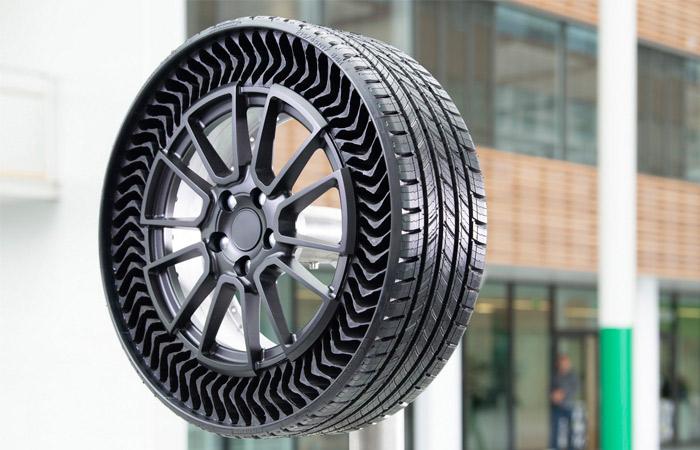
Michelin 3D printed Uptis tires
French tire manufacturer Michelin launched its first prototype tire using additive manufacturing technology in 2019. These tires are called Uptis (unique puncture resistant tire system), designed to be air free to reduce the risk of blowouts and other air leakage failures caused by blowouts or road hazards. The reason why this design is possible is because of AM. If successful, we can expect Uptis to equip some cars before 2024. Finally, these puncture resistant tires can also reduce waste and promote sustainable travel (one of the goals of the company's future travel vision).